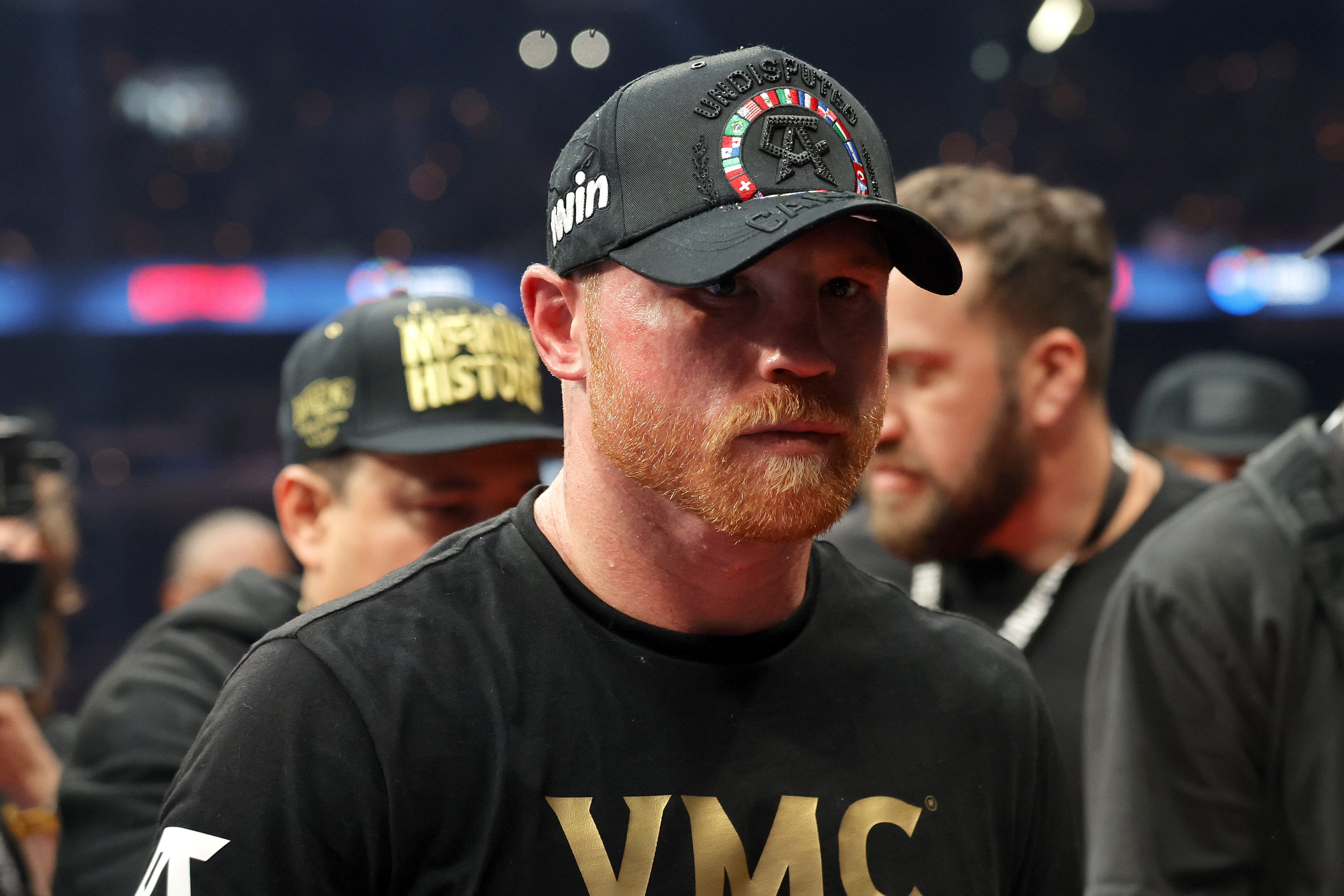
Saul "Canelo" Alvarez challenges Christian Mbilli for the WBC super middleweight title Saturday in a Saudi Arabia that's been under attack. (Hayden Hodge, Yahoo Sports) Elliot Worsell Uncrowned Wed, October 28, 2026 at 5:25 PM UTC · 19 min read In 1993, Wu-Tang Clan used the backronym C.R.E.A.M. (Cash Rules Everything Around Me) to explore the idea that we are all slaves to the dollar and that cash is king. Throughout the song, various members of the group took it in turns to rap about selling drugs or sticking up white boys on ball courts, anything to get by. It was, for all its swaggering energy, a cautionary tale; closer to a lamentation than a celebration.
In boxing, the same backronym is applicable. It can be applied not only in its original form, but will make just as much sense if you replace the word "Cash" with "Canelo." After all, in boxing, Saul "Canelo" Alvarez rules everything around us. He has for some time.
For proof of this, consider how the Mexican's WBC super middleweight title challenge against Christian Mbilli in Saudi Arabia on Saturday will proceed as planned despite the ongoing missile and drone attacks in Riyadh and the closing of King Khalid International Airport. Consider, too, if only for context, the fact that last Wednesday the U.S. State Department was concerned enough to order non-emergency government employees and their families to leave Saudi Arabia following a series of deadly attacks by Houthi rebels, which have so far claimed the lives of at least 20 people and injured at least 370.
"Iranian-supported Houthis have increasingly engaged in hostilities against Saudi Arabia, including attacks on civilian airports and other critical infrastructure resulting in civilian casualties and severe travel disruptions," said State Department spokesperson Tommy Pigott. "The safety and security of Department personnel and their families remain our highest priority, and we will continue to take all necessary steps to protect and support them."
As expected, several major sporting events in Saudi Arabia have been canceled due to the recent attacks, including the Six Kings Slam tennis tournament, the Saudi International golf tournament, and even a world title fight on Alvarez's own card . However, the world championship boxing match between Alvarez (63-3-2, 39 KOs) and Mbilli (29-0-1, 24 KOs) has somehow stood firm and survived. Not only has Canelo made the trip to Riyadh, but Canelo, according to Turki Alalshikh at least, "fears nothing."
True or not, we can be sure of this much: Canelo, now 36 years of age, has not boxed since losing to Terence Crawford 13 months ago and would, in an ideal world, box again after this weekend as soon as February. The reason for that is quite simple. "I want to fight quick, like in February, because I have two fights left in Riyadh," he told The Ring . "So, I want to fight this one in Riyadh [against Mbilli], and then in February, the next one."
In other words, Canelo wants to get in and get out — as fast as he can. This pertains to Saturday night, when he challenges once more for the WBC super middleweight belt, and perhaps more generally, too. He is, after all, now on borrowed time. His conqueror, Terence Crawford, announced his own retirement at the end of last year and Alvarez, who turned professional at the age of 15, will be aware he has only so many big fights left. For now, he might be content to take the vast sums of money on offer in Saudi Arabia. But, beyond that, one would presume he has other plans. The kind of plans that bring him closer to home. The kind of plans that make him feel more comfortable and further enhance his legacy.
Until then, he will naturally go where the cash is, safe in the knowledge that everyone will follow. They will follow Canelo, irrespective of risk, because the sport ultimately revolves around him. More than that, the sport still needs him.
One man who has followed Canelo to Riyadh this week is Robert Diaz, the former longtime matchmaker for Golden Boy Promotions who has followed the Mexican great for some time. His wife, Karla, has worked for Alvarez for 15 years and therefore it was never a question that the couple would end up in Riyadh this weekend. Both knew it wouldn't be as easy getting there as it was when Alvarez fought William Scull in 2025 , of course, but that wasn't to say it couldn't be done.
"It was alright," Diaz told me last Friday. "I flew from LA to Rome, which was fine, and then Rome to Qassim Airport [in Buraidah, Saudi Arabia], but we couldn't take off because of luggage. There was a little delay, but it wasn't to do with the attacks or anything.
"Then, once we got in the air and landed, we had to go to Riyadh on the road for four hours. But we got here eventually and everything seems fine — so far."
Though keen to stress "so far," Diaz was just as keen to affirm his confidence in a situation like this one. "There's been no indication that it [the event] would get cancelled," he said. "You would think that would be a possibility, but when everything seemed to be moving forward, we were like, 'Are you sure?' And yeah, they were. They were buying travel and arranging everything, so at that point it was, 'OK.'
"It's funny because last year, after Canelo fought here [against Scull], I ended up going to Pakistan to do a WBA (World Boxing Association) event and they were at war with India. The airspace kept closing while I was there and there was a chance we weren't going to get out in time. In the end, though, we were fine. So, with this one, there was a sense of, 'Been there, done that. Let's go.'"
Canelo Alvarez vs. Christian Mbilli appears destined to happen, for better or worse.
The thing is, they could have all been in Las Vegas, the fight capital of the world, this weekend. That is where fight fans typically gather in large numbers and where Canelo Alvarez is always welcome. It is there that, since the retirement of Floyd Mayweather, Canelo has become a headline attraction, often appearing at the T-Mobile Arena or MGM Grand on Cinco de Mayo and Mexican Independence Day.
In fact, the last time I saw Canelo in Las Vegas, he was there to complete his trilogy with Gennadiy Golovkin in 2022. It was September, the weekend of Mexican Independence, and for the Grand Arrivals at the MGM Grand the fighter was welcomed by the trumpets and violins of a mariachi band, as well as scores of screaming girls wearing bandanas. Then on Friday night, 24 hours before the fight, there was sudden gridlock along The Strip as countless heavy-duty vehicles sporting Mexican flags and relentlessly beeping horns crawled into town, windows down, heads out.
At one point, just to gauge the level of his popularity, I decided to visit the Grand and Co. shop in the MGM Grand lobby. That tends to be where fight merchandise is sold ahead of a big event and, for Canelo-Golovkin III, they were selling merch for both boxers, with one clearly outselling the other. "Canelo sells more by quite a distance and always outsells his opponents whenever he fights here," revealed Jodi, who ran the store and had been working there "too long to remember and long enough to remember them all [the great boxers]." She then shot me a look of horror when I had the nerve to propose Canelo's selling power might be comparable to Floyd Mayweather's. "Oh, come on," Jodi said. "Mayweather was much more popular. Him against [Manny] Pacquiao [in 2015]?" She rolled her eyes while making a whooshing sound with her mouth. "That was like nothing else. But, of course, they're both retired now and we miss them. Canelo is the next best thing."
While Mayweather remains the undisputed king of Las Vegas, Canelo did manage to do something in America that Mayweather never did: fight regularly in stadiums. This he did against Terence Crawford in his last fight (Vegas' new Allegiant Stadium), as well as in fights against Liam Smith and Billy Joe Saunders (AT&T Stadium in Texas), and Avni Yildirim (Hard Rock Stadium in Miami).
September 2025: 70,482 spectators attended Canelo vs. Crawford, the largest-ever attendance for an event held at Las Vegas' Allegiant Stadium.
"Canelo was a stadium fighter," said Doug Fischer, the editor-in-chief at The Ring magazine. "They were huge fights and it didn't matter who the f*** he was fighting. You think the people in Texas knew who Liam Smith was? Liam put up a hell of a fight that night, it was entertaining, but they didn't know who the f*** he was.
"Stadium fights are rare in America. What I noticed that night [in Texas] was that one, Mexico definitely showed up, and two, there were entire families there. I was struck by the number of young females and older women: Moms, aunties. Somebody would be holding a baby or pushing a stroller. They all had the Canelo stuff on. They had the merch, the headbands. It reminded me of [Julio Cesar] Chavez, back when he was the man, the idol. I'm thinking, ' This must have been what it was like to be at a Julio Cesar Chavez fight back in the early nineties .' I don't think he [Alvarez] reached the heights of Chavez, but he got close — as close as anyone has since. I can't think of a Mexican fighter or American fighter who can reach those heights now. I just don't see it."
The key to seeing anything, I suppose, is visibility. In the case of Canelo, that means showcasing him on stages that are large, accessible, and safe. His next fight with Mbilli, for instance, could have quite easily found a home in a stadium, whether in the U.S. or elsewhere. It is arguably a better fight than some of those stadium fights previously mentioned and Mbilli is no less famous than some of those Canelo opponents in the eyes of the public. Besides, Canelo is someone who is by now accustomed to having the biggest stage and audience possible. Anything less would seem to undermine what got him here.
"Canelo had a couple of things going for him when he started more than 20 years ago," said Fischer. "One, he was able to stay active by modern standards. Also, being Mexican, he turned pro when he was 15 and he caught the eye of certain network executives. Because he had white skin and red hair, there was a network, Televisa, that started showcasing Canelo and the ratings were really good. They liked him. He was a humble kid. He looked like a boy but he was in there with men and he was fighting tooth and nail and showing a lot of heart. He had an entertaining style and most of the time he would get a knockout, too, which helps.
"I think probably by the time he was 16 years old he was moved up to main-event status because he was boosting their ratings. For a couple of years, from 16 to 18, he was headlining shows on network television the way boxing stars used to in America. 'Sugar' Ray Leonard out of the Olympics was doing the same thing. He would be fighting at seven o'clock or eight o'clock on ABC to a huge market share.
July 22, 2009: An up-and-coming Saul Alvarez works out at Mexico City's New Jordan Gym.
"That's how all these guys became household names. Someone like Ray 'Boom Boom' Mancini was a guy I grew up watching on regular TV on a Saturday afternoon, and Canelo got that same treatment in Mexico as a teenager. Before he had even set foot on American soil as an 18-year-old, he was a household name in Mexico. Because of that, and because of the large Mexican contingent in Southern California, if there's a buzz about an athlete in Mexico it's going to translate here. So, there was already curiosity about him. He already had a ready-made fan base. For his first fight in the U.S., at a casino out here [Morongo Casino Resort & Spa in Cabazon, California], there were fans that had made banners and stuff. Even before 'Canelo' had caught on as a nickname, these banners would say: 'Saul Alvarez.' There was already a group — a little cheering section — waiting for him."
With his heart set on becoming an international star, this early interest from the Mexican people didn't go unnoticed or unappreciated. It was in fact something Canelo and his team were eager to cultivate.
"To his credit, he wanted to be a star; he wanted to be that guy ," said Fischer. "When he would do a media workout, or a workout open to the public, he would spar. He did that for a long time. Only Mexican fighters ever did that. Nowadays fighters are so secretive. They feel self-conscious even working the mitts in public. But the Mexicans, around the time I started covering the sport, would be having sparring sessions and the fans would take the day off work to go watch.
"That kind of ended in the '90s, but Canelo brought it back and was doing this until maybe 2012 or 2013. I appreciated it. So did others. He got it: I've got to give the dudes something to make them become Canelo fans . He understood that.
"Today, fans are not high on the priority list. And if the fans aren't a priority, then the fans aren't going to prioritize these fighters. So, how do you build somebody into an attraction, to the level of Canelo, if you don't have that kind of connection or relationship?"
Sept. 15, 2009: Mexico's Saul Alvarez cheers with the WBC youth welterweight belt after winning a fight in Puebla, Mexico.
"Solitude is an Anglo-Saxon concept," wrote Lucia Berlin in her short story "Fool to Cry." "In Mexico City, if you're the only person on a bus and someone gets on they'll not only come next to you, they will lean against you."
Since beating Kermit Cintron in Mexico City in 2011, Canelo Alvarez has fought just once in his home country and that was against John Ryder, from Great Britain, in 2023. That, too, is somewhere he could have fought Christian Mbilli this weekend. He could have fought him in Mexico City, where he stopped Cintron in Round 5, or even in Guadalajara, where he was pushed hard for 12 rounds by Ryder and where Alvarez was born and raised.
"It's strange," said Ryder, the last man to box Canelo in Mexico. "I don't actually think Canelo is as popular as you think he is in Mexico. A lot of people see him as a bit of a 'sellout.' He has always been thinking about the legacy he wants to leave behind, but he probably needs to take a fight back to Mexico and win the fans back. I know the stadium was packed for our fight, but around the hotel and stuff, there wasn't a lot of interest in it. It wasn't like everybody was talking about Canelo or supporting him. I think they genuinely see him as a 'sellout.'"
Ryder, who is now retired, added: "He has been a remarkable sportsman for Mexico and what he has done in the sport has been amazing. But I think a lot of his fans wanted these big events — these career-defining fights — in Mexico and to feel like they were part of it. Most people in Mexico can't afford these big trips to the U.S. to watch him at the T-Mobile Arena or the MGM Grand. That will have hurt his legacy a bit in their eyes. It won't hurt his legacy in terms of who he has fought and what he has achieved, but when most of your big moments have happened in Vegas …
"Once he is back from Saudi, all he probably needs is a fight at the Azteca [Stadium in Mexico City] to finish off his career. Get 100,000 fans in there and that will be the cherry on the cake for him and his career."
Although currently in Riyadh taking one day at a time, Robert Diaz is still able to imagine and predict Alvarez's future. He, like Ryder, sees the importance of bringing the show back home and repaying those fans who once made banners and booked days off work to watch their hero spar.
"I think that is definitely a goal Canelo has," said Diaz. "There have been reports that he has talked to the owner of the Azteca Stadium, where Julio Cesar Chavez once fought [against Greg Haugen in 1993]. There have also been talks regarding his last fight being in Guadalajara, where he is from. So, I believe that is something that is on his mind. It would be huge for him to be able to go back and say, 'Thank you for all the love and support.'"
Fighting Canelo in Mexico was, according to Ryder, a "crazy experience," of which he has only fond memories. He might have lost the fight, but the acclaim he received from the Mexican fans, all of whom acknowledged his warrior spirit, felt almost as good as winning it. Indeed, whereas some of Canelo's previous opponents deemed victory the signing of the contract — that is, securing a career-high payday — Ryder viewed Canelo as more than just a cash cow. For the 12 rounds he spent in his company, he saw him as a beatable equal.
"I was a Canelo fan long before I was a rival of his," Ryder said. "It was kind of a pinch-me moment, but I had done the work not to show him too much respect or get too emotionally involved. The fight was just work time. It was the way it had to be. We were there to have a fight and that's how I wanted it to be. I didn't want to be all nicey-nicey with him. It was strictly business.
"On the night he wasn't as physically strong as I thought he would be. I was able to push him around a bit. If not for my nose 'going' in round two, I might have had even more success. But his accuracy was unbelievable, brilliant. When he throws a shot, he throws it with bad intentions and nine out of 10 times he lands it. His ring craft is great: his little double steps, how he feints, how he purposely telegraphs something and then throws something else. He is a special fighter."
Zapopan, Mexico: Fans rush to take a photo of Canelo Alvarez prior his fight against John Ryder at Akron Stadium on May 6, 2023.
Unlike world champions, who can be located on every street corner in boxing, special fighters are rare. Customarily, a special fighter is the kind of fighter who can bring tens of thousands of Mexicans to Las Vegas on Cinco de Mayo and Mexican Independence weekend; a special fighter is a fighter who can fill outdoor stadiums in countries not known for stadium fights; a special fighter is a fighter who can ensure a fight in a "warzone" somehow takes place.
A special fighter is also someone whose absence the sport tends to feel.
"One hundred percent we will miss him," said Ryder. "We never really replaced Mayweather, did we? Once Canelo goes, we need someone who can command those two big dates — in May and September — and deliver big fights every year. Canelo tried to fill that gap when Mayweather retired, but he still wasn't able to live up to the hype of Mayweather."
"We go through this process of missing fighters and mourning them with each generation," said Diaz. "We missed Julio [Cesar Chavez] when he was gone, we missed Oscar [De La Hoya] when he was gone, and we missed Floyd when he was gone. We will miss Canelo the same way. But there seems, at least historically, to always be that next guy who fills in. Hopefully we find it in a [Jaime] Munguia, or an [Rafael] Espinoza, who I am really high on. He also fights on Saturday's card [in Riyadh] and he is a kid with a lot of discipline and talent.
"Throughout history Mexico has always been very important to boxing and boxing has always been very important to Mexico. We have had a lot of world champions and idols from Mexico, but we haven't always had a lot of big global stars. Now, because the focus is no longer on creating these heroes and these idols, I think Canelo is that last Mohican; the last guy capable of drawing thousands of people over to the big events. He has maybe two or three fights left and we need to appreciate that. It always happens: once they are gone, even the haters start missing them. We will soon miss the kind of nights Canelo has given us."
This Saturday, on shaky ground, Saul "Canelo" Alvarez will give us another one of those nights, albeit slightly different from the usual. After that, at some point in 2027, he will get on a bus in Mexico City, sit beside someone who speaks his language, and lean against them in order to rest his heavy head on their shoulder. " Bienvenido a casa," he will then hear them say. "Te extrañamos."
Or in English: "Welcome home. We have missed you."
Elliot Worsell is a boxing writer whose byline first appeared in Boxing News magazine at the age of 17. He has, in the 20 years since, written for various publications, worked as press officer for two world heavyweight champions, and won four first-place BWAA (Boxing Writers Association of America) awards. In addition to his boxing writing, Worsell has written about mixed martial arts for Fighters Only magazine and UFC.com. He has also written two non-fiction books, one of which, Dog Rounds, was shortlisted at the British Sports Book Awards in 2018. He lives in London, England and his writing can currently be found at Uncrowned.com and Boxingscene.com.
Share Comments Join the conversation! Just be kind to your fellow humans and keep things on topic. We'll help by moderating comments according to our community guidelines .
Source: Sports



0 Comments